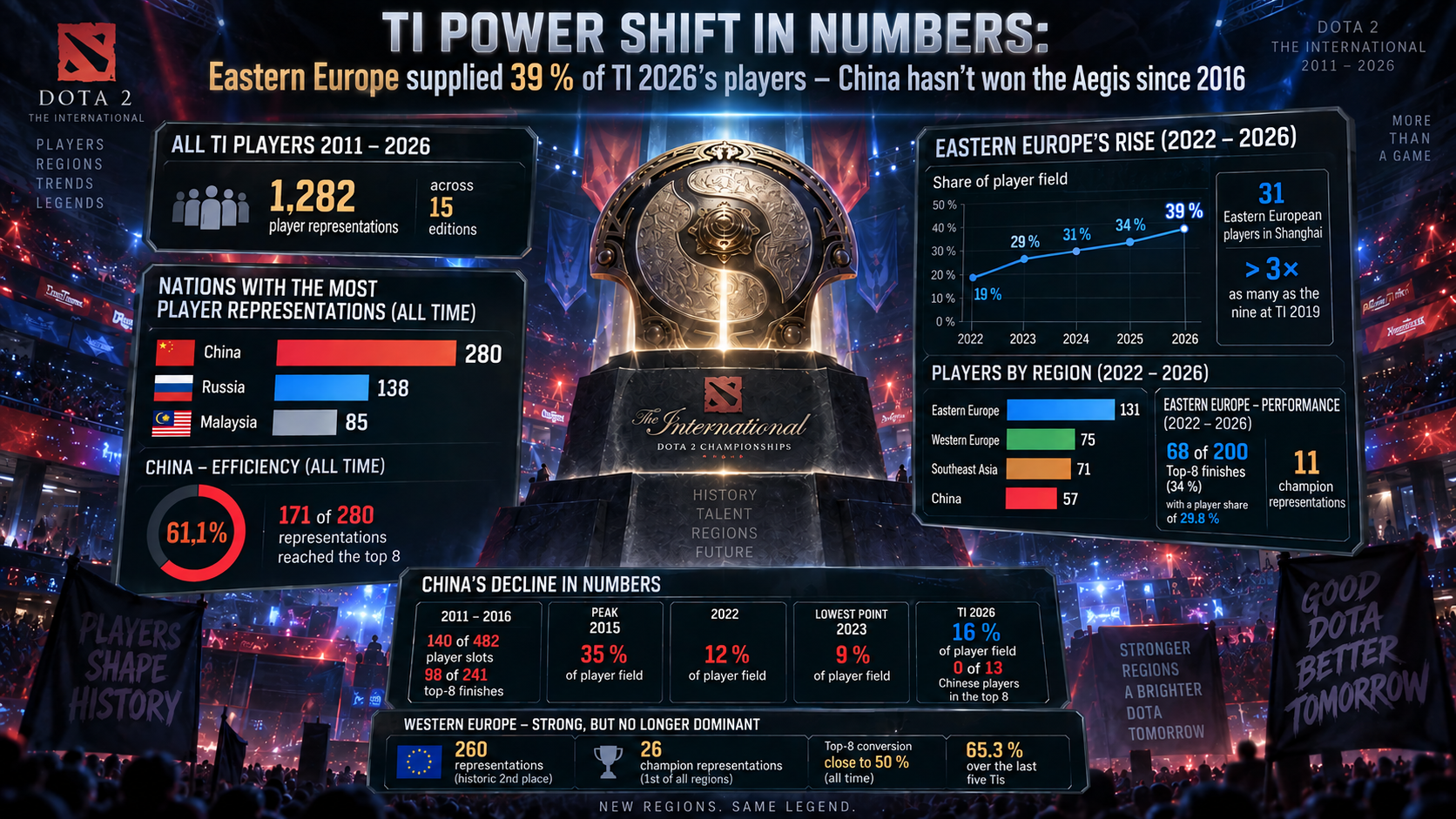
Team Spirit’s third Aegis in Shanghai was the headline, but a new 15-year dataset shows it was not an outlier. Esports Insider has tracked every player who competed at The International in Dota 2 from 2011 to 2026 – 1,282 player representations across 15 editions – and sorted them by where the players actually come from rather than where their organisations are registered. The picture is unambiguous: the centre of gravity at Dota 2’s biggest event has moved from China to Eastern Europe, and the trend is still accelerating.
China’s decade-long slide
China remains the most represented nation in TI history with 280 player appearances, well ahead of Russia (138) and Malaysia (85). Chinese players also converted at a remarkable rate, reaching the top eight in 171 of those appearances – a 61.1 percent hit rate that no other large region matches.


Almost all of that, however, was built before 2017. Between 2011 and 2016 China provided 140 of 482 player slots and 98 of the period’s 241 top-eight finishes, with Invictus Gaming (2012), Newbee (2014) and Wings Gaming (2016) lifting the Aegis. Since Wings, nothing. China’s share of the field peaked at 35 percent in 2015, fell to 12 percent by 2022 and bottomed out at nine percent in 2023. It bounced back to 16 percent at TI 2026, but none of the 13 Chinese players in Shanghai finished in the top eight – on home soil.
Eastern Europe’s rise is regional, not just Spirit
Across the five Internationals from 2022 to 2026, 131 players came from Eastern Europe, compared with 75 from Western Europe, 71 from Southeast Asia and just 57 from China. The region’s share has grown every single year: 19 percent in 2022, 29 in 2023, 31 in 2024, 34 in 2025 and 39 percent at TI 2026. The 31 Eastern Europeans in Shanghai were more than three times the nine who played at TI 2019.
Volume alone would be notable, but the region also outperforms it. Eastern Europe took 68 of the 200 top-eight places available in that five-year window (34 percent) from a 29.8 percent player share, plus 11 champion representations. Russia (138 appearances) and Ukraine (70 appearances, 32 top-eight finishes, eight title runs) account for roughly 89 percent of the region’s total output.
Team Spirit sit at the centre of the story, and not only in Dota. The same organisation’s Counter-Strike roster just won back-to-back BLAST titles in Porto, making Spirit the rare club that is world number one in two tier-one esports at once.
Where Western Europe fits
Western Europe is second all-time with 260 appearances and actually leads every region with 26 champion representations. Its top-eight conversion sits close to 50 percent historically and at 65.3 percent over the last five TIs – competitive, but no longer dominant. The late bracket that China once owned alone is now shared between the two European regions.
What it means for bettors
Regional priors matter when pricing a TI bracket. Eastern European teams have gone from fringe presence to the largest and most efficient talent pool at the event in half a decade, and the data suggests that advantage is structural rather than tied to one roster. Chinese sides, by contrast, keep arriving with strong domestic results and leaving early, which is worth remembering when their pre-tournament odds look attractive. With Team Falcons out of Dota 2 and Spirit’s dynasty intact, the open question for 2027 is whether any region can build the depth to close the gap – anyone planning to back a challenger should at least compare the welcome offers available for esports betting before locking in early prices.
Related:

Leave a Reply
You must be logged in to post a comment.