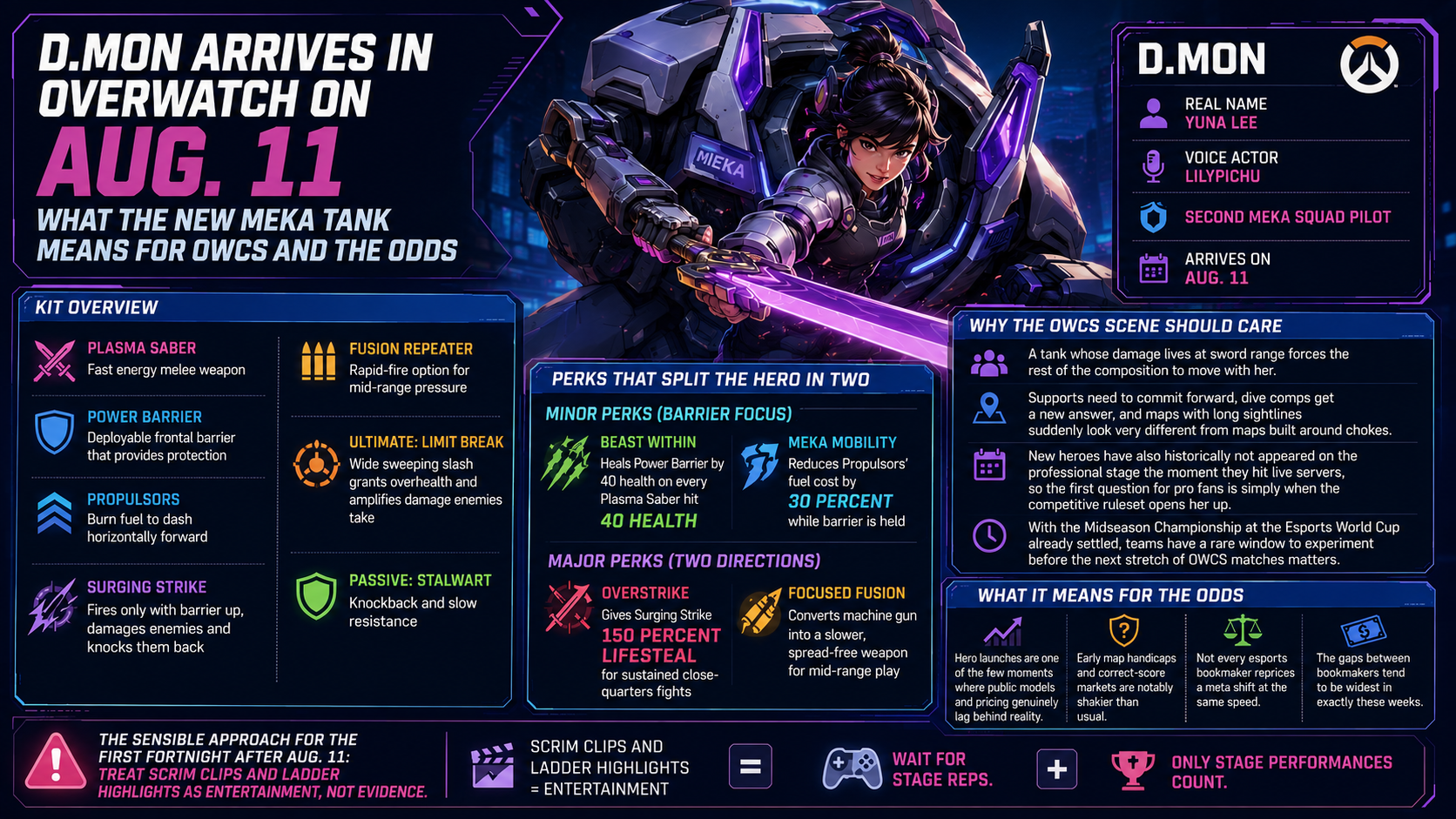
Blizzard is about to hand tank players their strangest toolkit in years. D.Mon, the new hero launching with Season 4: Heroes of Busan, lands in Overwatch on Aug. 11 — and unlike nearly every tank before her, her main weapon is a sword.
A second MEKA pilot, built for melee range
D.Mon, whose real name is Yuna Lee and who is voiced by streamer LilyPichu, joins D.Va as the roster’s second MEKA Squad pilot. Her mech follows the same rule set: destroy it and she ejects, fighting on foot with a Portable Fusion Repeater until she banks enough ultimate charge to Call Mech and climb back in.


Inside the mech, though, she plays nothing like her squadmate. The Plasma Saber is a fast energy melee weapon, supported by a deployable frontal Power Barrier and by Propulsors that burn fuel for horizontal bursts of speed. Surging Strike only fires while the barrier is up, damaging enemies and shoving them backwards, and Fusion Repeater offers a rapid-fire option for the moments when walking into a team fight with a sword would be suicide. Her ultimate, Limit Break, is a sweeping slash that grants her overhealth while amplifying the damage her targets take.
She also carries the Stalwart sub-role passive, which gives her knockback and slow resistance — a quiet but important detail for a hero who has to survive the walk into range.
Perks that split the hero in two
Both minor perks feed the barrier. Beast Within heals Power Barrier by 40 health on every Plasma Saber hit, pushing her deeper into brawl range, while Meka Mobility cuts the fuel cost of Propulsors by 30 percent whenever the barrier is held. The majors then send her down two very different roads: Overstrike gives Surging Strike 150 percent lifesteal for sustained close-quarters fights, and Focused Fusion converts the machine gun into a slower, spread-free weapon for teams that would rather keep her at mid range.
Why the OWCS scene should care
A tank whose damage lives at sword range forces the rest of the composition to move with her. Supports need to commit forward, dive comps get a new answer, and maps with long sightlines suddenly look very different from maps built around chokes. New heroes have also historically not appeared on the professional stage the moment they hit live servers, so the first question for pro fans is simply when the competitive ruleset opens her up. With the Midseason Championship at the Esports World Cup already settled, teams have a rare window to experiment before the next stretch of OWCS matches matters.
What it means for the odds
Hero launches are one of the few moments where public models and pricing genuinely lag behind reality. Nobody — including the teams — has reliable data on how a melee tank performs at the top level until a few series have been played, which makes early map handicaps and correct-score markets noticeably shakier than usual. Not every esports bookmaker reprices a meta shift at the same speed, and the gaps between them tend to be widest in exactly these weeks. Bettors who want to stay active through the uncertainty often size down and lean on esports betting bonuses to soften the variance rather than chasing a read they do not have yet.
The sensible approach for the first fortnight after Aug. 11 is to treat scrim clips and ladder highlights as entertainment, not evidence. Wait for stage reps.
Related:
- Overwatch Betting Guide
- All You Need to Know About Welcome Bonuses
- All to Know About No Deposit Bonuses

Leave a Reply
You must be logged in to post a comment.