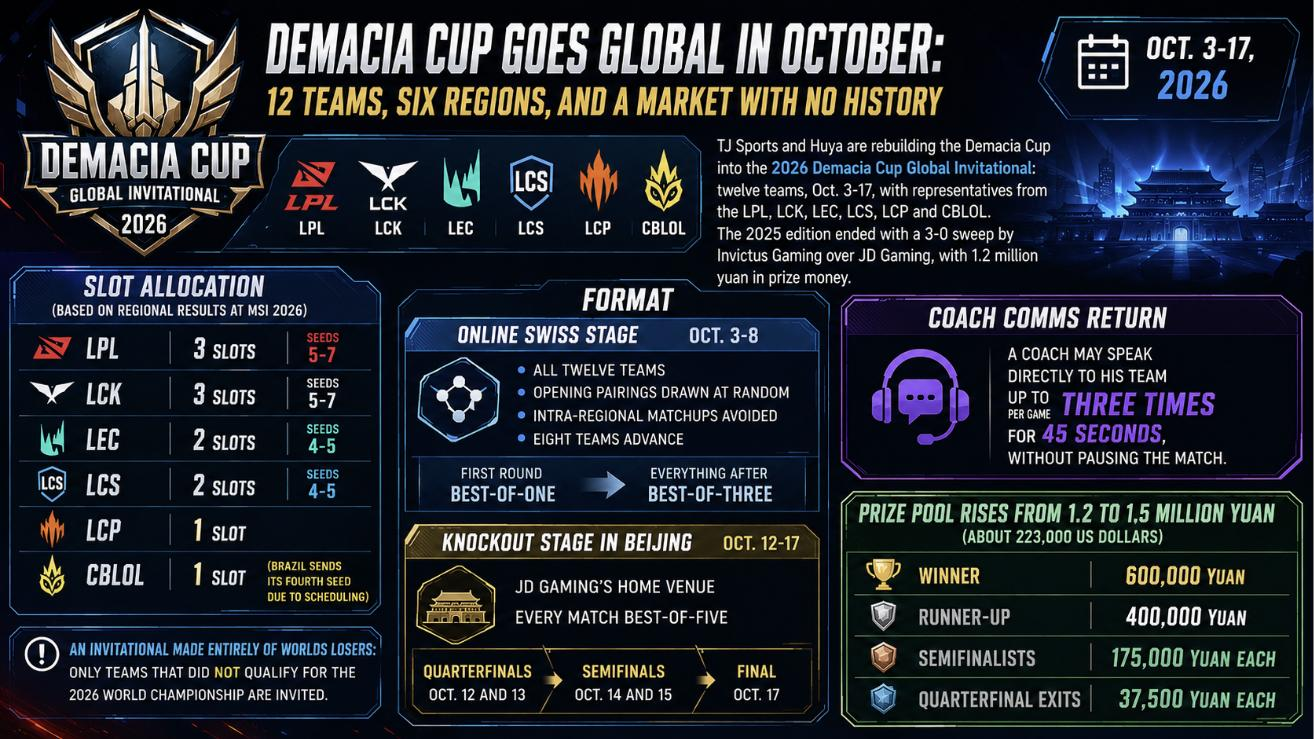
League of Legends’ longest-running Chinese offseason event is leaving China. TJ Sports and Huya have rebuilt the Demacia Cup as the 2026 Demacia Cup Global Invitational, a 12-team tournament running from Oct. 3 to 17 with representation from the LPL, LCK, LEC, LCS, LCP and CBLOL. After more than a decade as a domestic competition — the 2025 edition ended with Invictus Gaming sweeping JD Gaming 3-0 for a share of a ¥1.2 million pot — the cup suddenly becomes one of the few genuinely international dates on the League of Legends betting calendar that Riot does not run itself.
An Invitational Built Out of Worlds Rejects
The entry rules are what make this event strange, and interesting. Invitations go only to teams that miss the 2026 World Championship. The LPL and LCK each receive three slots, reserved for their highest-ranked eligible sides in fifth through seventh. The LEC and LCS get two apiece, going to fourth and fifth place. The LCP and CBLOL receive one each, with Brazil sending its fourth-placed team because of how the regional schedule falls.


The split is not arbitrary: it mirrors regional performance at MSI 2026, with the top two regions granted three invitations, third and fourth getting two, and the rest one. If a team declines, the next eligible side moves up. That means the actual 12-team field will not be settled until the regional seasons and the Worlds qualification races finish — likely only days before the Swiss stage begins.
Format: Swiss Online, Then Beijing
The tournament opens with an online Swiss stage from Oct. 3 to 8. All 12 teams enter the same pool, opening pairings are drawn at random while keeping same-region matchups apart, and eight survive. Round one is best-of-one; everything after that is best-of-three.
The surviving eight then travel to JD Gaming’s home venue in Beijing for a single-elimination bracket from Oct. 12 to 17, with every knockout match played as a best-of-five. Quarterfinals run Oct. 12 and 13, semifinals Oct. 14 and 15, and the grand final lands on Oct. 17. Coach Comms returns for the offline stage, letting a coach talk to players up to three times per game for 45 seconds without stopping play — a system first trialled at the 2025 Demacia Cup before appearing in the LCK Cup and LCP.
The prize pool rises to ¥1.5 million (roughly $223,000) from ¥1.2 million, with ¥600,000 to the champion, ¥400,000 to the runner-up, ¥175,000 to each semifinalist and ¥37,500 for quarterfinal exits.
Why the Prices Will Be Soft
This is close to a worst-case scenario for accurate pricing, which is exactly why it is worth watching. Cross-region head-to-head data between fifth-to-seventh place teams essentially does not exist, the field is unknown until late, and motivation is a genuine unknown — some of these rosters will be playing weeks after a season-ending failure, others will treat Beijing as an audition ahead of roster moves.
Add a best-of-one opening round, where a single early misstep in draft can flip a series that never happens, and the Swiss stage becomes a variance machine. The bracket, all best-of-fives, should be far more honest. Anyone planning to follow it from the first day is better off treating the Swiss round as observation and saving stakes for Beijing — and if you are opening an account specifically for October, the welcome bonus wagering terms matter more than the headline figure attached to them.
Related:
Leave a Reply
You must be logged in to post a comment.